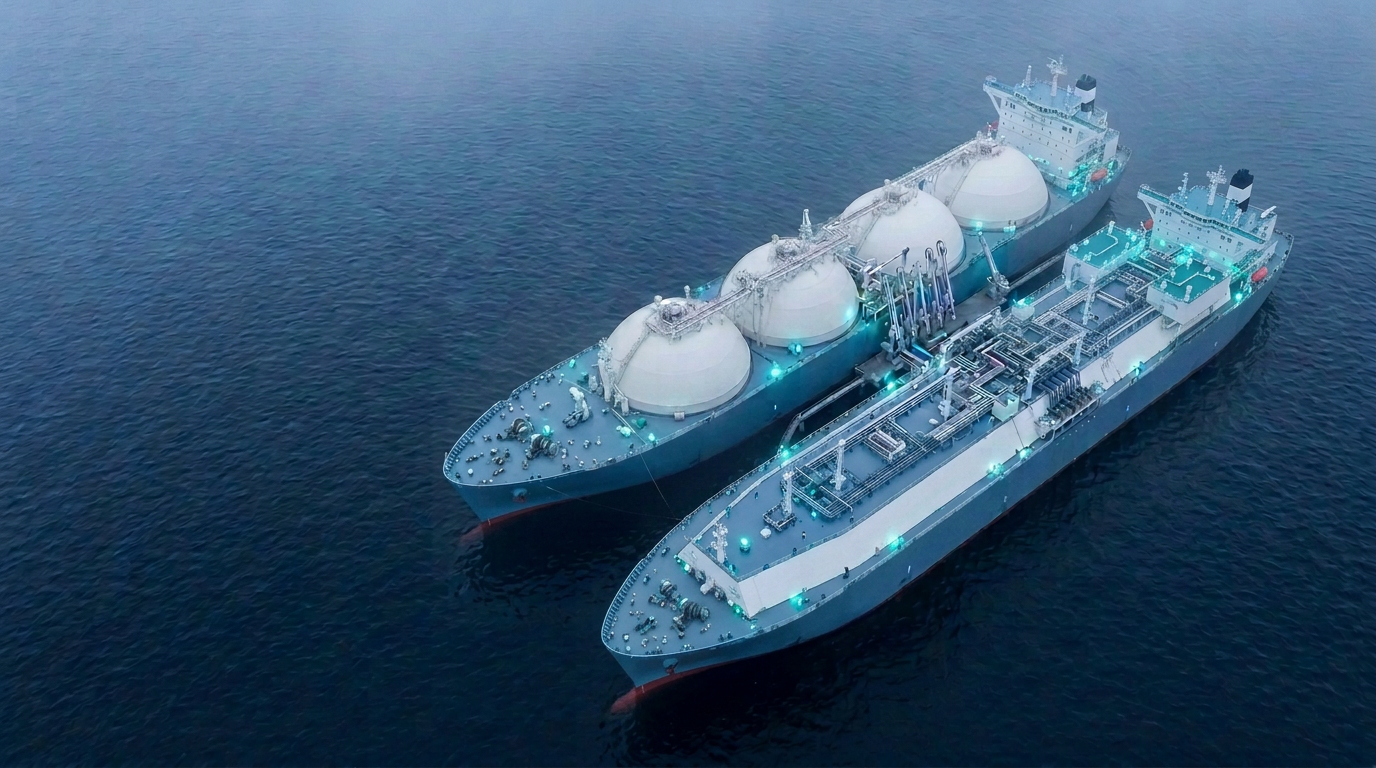
Ship-to-ship LNG transfer review
Compatibility and vetting review for ship-to-ship LNG transfers, with every finding traced to its source document.
Know before you moor.
A nominated carrier submits a large set of documents. The platform reads that submission, cross-checks it against the terminal's own controlled requirements, and presents the result to a marine superintendent for decision.
The review problem
A large submission holds more cross-references than a reader can hold in their head.
The same parameter, asked twice
One parameter is requested in several documents, and the answers given in each can differ from one another.
Requirements spread across manuals
Controlled manuals, working forms and terminal particulars are maintained separately, and are not always reconciled with each other.
No systematic contradiction check
A reviewer working through a large submission by hand has no systematic way to surface a contradiction between two documents.
How it works
Submit documents
The nominated carrier's document set is uploaded as a single submission against a case.
Cross-check against requirements
Each submitted value is read, located, and compared against the terminal's controlled requirements.
Superintendent decides
Findings are presented for review. The platform never issues a clearance itself — clearance is granted only by the superintendent.
What it does not do
The platform advises, evidences and drafts. It does not decide.
Every finding is a recommendation. It carries the source document, the exact location within that document, the requirement applied and the comparison performed, so a reviewer can verify it independently rather than take it on trust.
Acceptance remains a human decision. It is recorded with the reviewer's name, their reason and the time it was made, and that record is added to — never overwritten.
Evidence trail
What a finding looks like
Parameter
MNF-SIZE — Manifold nominal size
Requirement
Liquid manifold nominal size shall be DN 400.
Sample Terminal Operations Manual · Rev. B · Clause 4.2.1
| Submitted document | Location | Value found | Status |
|---|---|---|---|
| SAMPLE-DOC-01 | Sheet MANIFOLD!C22 | DN 400 | Matches |
| SAMPLE-DOC-02 | Page 14, table 3 | DN 400 | Matches |
| SAMPLE-DOC-03 | Page 6, text match | DN 350 | Differs |
The comparison is shown in full so the reviewer can open each source document and land on the exact location cited.
Who it is for
Terminal operators
Applying their own controlled requirements to every nomination consistently.
Marine superintendents
Reviewing evidenced findings and recording the clearance decision.
Vessel managers
Seeing what was asked of a submission and what still needs answering.